

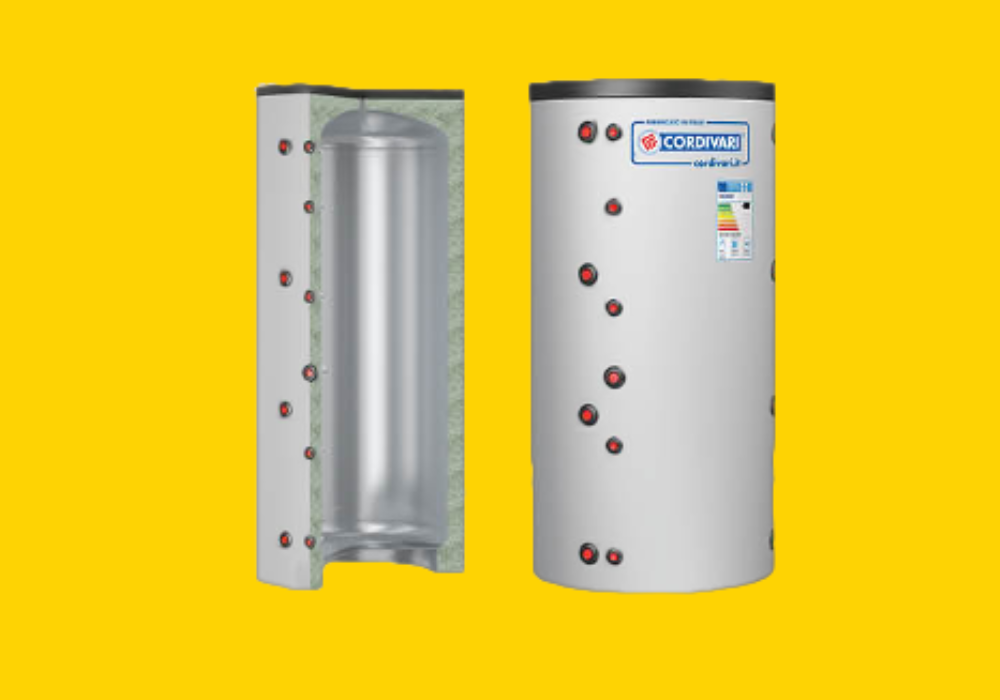
Heat Pump Buffer Tank vs Standard Buffer Tank: What’s the Difference?
When specifying a buffer tank, it’s important to understand that not all buffer tanks are designed for the same purpose.
While both heat pump buffer tanks and standard buffer tanks add water volume to a heating system, they are intended to solve different challenges. Choosing the right type can improve system performance, reduce unnecessary cycling and ensure the heat source operates as intended.
Why Are Buffer Tanks Used?
A buffer tank is a vessel that stores system water within a closed heating system, increasing the amount of water available to the heat source and providing thermal storage where required. Unlike a domestic hot water cylinder, the stored water is used within the heating system rather than for domestic hot water.
The additional water volume stored in the buffer tank can help:
- Increase system volume
- Reduce cycling of heat sources
- Store thermal energy
- Improve system stability
Why Choose a Heat Pump Buffer Tank?
Heat pumps operate most efficiently when they are allowed to run for longer periods at lower temperatures.
Where the water volume within a heating system is too low, the heat pump can quickly satisfy demand and shut down. This repeated starting and stopping, known as short cycling, increases wear and can reduce overall system efficiency.
By adding additional water volume, the heat pump can run for longer before reaching its target temperature, reducing the number of starts throughout the day.
A dedicated heat pump buffer tank can also:
- Support heat pump defrost cycles
- Assist with hydraulic separation where required
- Provide additional system volume where minimum water content requirements must be met
Many heat pump manufacturers specify a minimum system water volume. Where this cannot be achieved through the heating system alone, a buffer tank may be used to provide the additional volume required.
LoCO2 Heat sell the Cordivari Volano BS range which has been specifically designed for heat pump applications and can be used with both heating and cooling systems. It provides additional system volume while helping to reduce unnecessary start-stop operation of the heat pump.
Why Choose a Standard Buffer Tank?
A standard buffer tank is typically selected when the primary objective is thermal energy storage rather than increasing system volume.
This is particularly common with biomass boilers and other heat sources that generate heat intermittently or produce more heat than the building requires at a given time.
Rather than allowing the heat source to cycle on and off, surplus energy is stored within the buffer tank and released when heating demand increases.
The Cordivari Puffer range is designed for this type of application and is commonly used alongside woodchip and pellet biomass boilers and other systems with discontinuous heat production.
Key Differences Between a Heat Pump Buffer Tank and a Standard Buffer Tank
| Feature | Volano BS Heat Pump Buffer Tank | Puffer Buffer Tank |
| Primary purpose | Increase system volume and reduce cycling | Store thermal energy |
| Typical application | Air source and ground source heat pumps | Biomass and renewable heating systems |
| Supports defrost cycles | Yes | Not typically required |
| Heating and cooling applications | Yes | Primarily heating |
| Designed to reduce compressor starts | Yes | No |
| Focus on thermal storage capacity | Secondary | Primary |
| Typical installation | Heat pumps | Biomass and renewable heating systems |
What About Larger Commercial Systems?
Larger commercial and renewable heating systems often require significantly more thermal storage than a domestic heat pump installation.
In these cases, larger capacity buffer tanks may be required to provide significant thermal storage for biomass boilers, district heating schemes or commercial renewable heating systems.
The Cordivari Puffer range is available in capacities up to 20,000 litres, while the Puffer Compact range has been developed for installations where plant room height is restricted. Its design makes it suitable for low-ceiling plant rooms while still providing substantial thermal storage capacity.
Which Buffer Tank Is Right for Your Project?
If the aim is to improve heat pump operation, increase system volume and reduce compressor cycling, a dedicated heat pump buffer tank such as the Cordivari Volano BS range is usually the preferred choice.
If the aim is to store larger quantities of thermal energy from a biomass boiler or another intermittent heat source, a standard buffer tank such as the Cordivari Puffer range is generally more appropriate.
Understanding the difference between the two can help ensure the correct level of thermal storage and system performance for the heat source being used.
the two products may appear similar, they are designed around different system requirements. Selecting the correct type of buffer tank can help ensure the heating system performs as intended while providing the right balance of system volume and thermal storage.